Creating Pathways to Child Wellbeing and the Prevention of Crime
A long-term research and action program that was initiated in 1996 by Emeritus Professor Ross Homel, AO, and which continues today.
The core Pathways research team comprises Ross Homel, Kate Freiberg, Sara Branch, Jacqueline Allen, and Tara McGee.

The overall aim of the program is to strengthen the development system for children, with a long-term view to improving the wellbeing of children, reducing youth crime, and broadly promoting both human and community development. The basic focus is policy pathways, since the project aims to re-organise government, as well as societal priorities and practices, and move tertiary, punitive responses to social problems (especially for youth crime and substance abuse) to primary prevention - the prevention of problems before they emerge or become entrenched.
The program has been funded by a wide variety of agencies including the John Barnes Foundation, The Australian Department of Social Services, and the Australian Research Council through Grant Numbers C0107593, LP0560771, DP0984675, DP140100921, LP130100142, and LP170100480.

Phase 1 (1996-2001): Review and Plan
Inspired by publications by the late Professor David Farrington from Cambridge University, in 1996 Ross Homel posed the question: what is Australia doing in light of the growing evidence for the crime prevention effectiveness of early-in-life initiatives like the Perry Preschool Project? The answer at the time appeared to be “nothing much,” although early intervention – as opposed to early or primary prevention - was a well understood concept in areas such as mental health and disabilities research.
Ross set about securing funding and in 1997 was awarded a grant by the Commonwealth Department of the Attorney General to bring together and lead a multidisciplinary team of eminent Australian researchers (called the Developmental Crime Prevention Consortium) to document and review what developmental prevention and early intervention initiatives were being implemented at the time in Australia that could be related to the prevention of youth crime. A major objective was to describe in some detail the principles of development crime prevention and to make recommendations about what Australia could do to strengthen its social policies.
This work culminated in a report published in late 1999, Pathways to Prevention: Developmental and Early Intervention Approaches to Crime in Australia. This foundation report has had a major influence in Australia on policies in such diverse fields as mental health, substance abuse, child protection, and special education, but much less impact on state government policies and practices concerned with youth crime, where the primary prevention of youth crime is rarely a focus. The report did succeed in putting developmental prevention and early intervention onto the ‘social policy map’ in Australia in a manner that made them central, rather than peripheral, to policy debates in some fields such as youth mental health and drug policies, but the gap between rhetoric and the old realities in these fields remains very large. State government policies remain very largely focused on accountability and punishment rather than research-informed primary prevention and early intervention on youth crime.
A major recommendation of the 1999 report was that a community-based demonstration of developmental crime prevention should be designed and implemented. Ross accepted this challenge and in 2000 and 2001 undertook the task of attracting funding from philanthropic and state government sources and from the Australian Research Council. At the same time, he worked with colleagues to select a suitable disadvantaged community and begin an ongoing process of engagement, including paying local students and parents to design and implement a survey of the needs of children in the area.

The Mission Australia team invested much in the building of trust through community relationships and constructed and evaluated a holistic suite of program activities that were available to all families on a completely voluntary basis, including many participating in the Communication Program. These activities, which were often situated in schools and involved teachers, were based on community-generated data on needs, maximized engagement with the most hard to reach families, employed a mixture of professional staff and community workers without formal qualifications who had a high degree of credibility with their ethnic communities (First Peoples, Pacific Islands or Vietnamese), and were tailored to the needs of each child or family by being strength-based and highly flexible in terms of type of service, duration, and intensity. Decisions about what programs to implement and the manner of implementation were not generally made by researchers but by the Mission Australia Service Manager and by teachers and school principals, although usually after extended discussion with researchers about goals and the research evidence.
Thus, the project incorporated a range of program activities, from facilitated playgroups to intensive family support, that represented a broad cross-section of services typically found in socially disadvantaged communities in Australia. The programs were, however, perhaps more than usually ‘research influenced.’ The Pathways Project (or Service, as it was termed by the Mission Australia team) was very successful in reaching out to families, especially those with a high level of need. Between 25% and 30% of all families with children enrolled at one of the seven primary schools participated in the service in any given year, with a total of 1,077 distinct families participating between January 2002 and June 30, 2011.
1,467 children from these families (30% of all enrolled children) participated over the ten years (nearly always with a parent): 16% First Nations, 26% Vietnamese, 15% Pacific Islanders, 16% other ethnicities, and 27% ‘Anglo-Celtic’ Australian. The mean number of contacts per family was 61; the mean period of total involvement was 76 weeks; and on average 3.5 service types were accessed, most commonly carer individual support; advocacy; and playgroups. These high levels of involvement, often over many months or years, underline both the extent of need in the area and the success of the Pathways team in building trust and offering resources that families really valued.
A 2024 evaluation report summarises the improvements in classroom behaviour, parental efficacy and empowerment, and child wellbeing achieved during the life of the project and since 2011. It documents in detail how improved behaviour brought about through the Communication Program combined with family support led to a reduction of more than 50% in the onset of serious youth offending. This Pathways Project effect was reflected in a community-wide reduction of more than 20% in rates of youth crime in the years when the communication program participants were potentially at risk.
A further paper explores the cost-effectiveness of the Communication Program. Results show that for every dollar spent, the Communication Program generated an average return of AUD7.65 from avoided court-adjudicated youth offending. The Pathways to Prevention Project is the first Australian early-in-life crime prevention initiative to present scientifically persuasive evidence for effectiveness in reducing the probability of onset of serious youth offending, offering a counternarrative to prevailing expensive youth justice policies centred on child accountability and harsh punishments.
The Pathways Project shared first prize in the 2004 National Crime and Violence Prevention Awards. In April 2004, the Prime Minister John Howard announced a new multi-million-dollar program, Communities for Children, that was implemented in 52 disadvantaged communities across Australia. This program was strongly influenced by the learnings from Pathways to Prevention. On December 7, 2006, the Prime Minister launched a report on the first five years of the Pathways Project at Parliament House in Canberra.
In 2024 the Pathways team won a further National Crime and Violence Prevention Award for the impact of the project in reducing serious youth crime. The 2024 report documenting these outcomes was rated as the best publication of the year in the field of crime prevention, winning the 2024 Adam Sutton Crime Prevention Award administered by the Australian and New Zealand Society of Criminology.
Phase 2 (2002-2011): The Pathways to Prevention Project
The Pathways to Prevention Project aimed to be a demonstration of how developmental initiatives in disadvantaged communities could be designed based on the science of human development in a way that empowered both residents and mainstream institutions such as schools and NGOs to mobilise resources to promote positive child development for all local children.
In specific terms, the project was designed to address the gap in knowledge about how to make commonly used family support and place-based child services including preschool and school more effective in the short and long term, and more generally how to make the developmental system more responsive to the needs of disadvantaged children.
Influential in its early design was evidence emerging from longitudinal research pointing particularly to low achievement, poor parental child-rearing behaviour, child impulsivity, and poverty as critical risk factors that should be addressed through multimodal approaches involving children, schools, families and the community. In developmental system terms, these risk factors highlight the frequently fractured relations between schools and families in socially disadvantaged areas, and the corrosive effects of poverty and social exclusion on the capacity of parents and carers to parent effectively. Bluntly put, families are stressed, and children are damaged because the developmental system is broken.
The project operated in a highly disadvantaged area of Brisbane as a research-practice partnership involving families, seven local primary schools, the Griffith University research team, the Queensland Department of Education, and national community agency Mission Australia. The Pathways area had a youth crime rate in the late 1990s more than eight times higher than the Brisbane average.
The first phase of the project in 2002 and 2003 incorporated an enriched preschool program focused on oral language development and communication skills for all 4-year-old children attending two of the seven free state preschools in the area. The link between poor oral language skills and difficult behaviour was a problem highlighted by all preschool teachers when they were asked in 2001 by a small team of residents and students trained by the research team to find out about the most pressing needs of children in the area. The Communication Program was fully integrated with the normal preschool curriculum and was developed and implemented by specialist Education Department teachers who worked closely with classroom teachers and the parents of the children. The aim was to integrate as tightly as possible the preschool classroom environment with the home environment, so that activities in each setting would be mutually reinforcing.

Phase 3 (2012-2020): The CREATE Project:
The research team embarked in 2012 on an 8-year research program that aimed to translate many of the findings and the methods developed in the Pathways to Prevention Project into existing government programs that funded partnerships in disadvantaged communities across Australia. Communities for Children (CfC), funded and administered through the Commonwealth Department of Social Services, was chosen as a suitable vehicle for the CREATE Project.
The CREATE model was developed toward the end of the Pathways to Prevention Project, in 2012. The model is a set of principles and an action methodology underpinned by good governance and community empowerment. CREATE is both an acronym and a framework that builds capacity for collective impact in communities by enhancing the ability of child-serving organisations to operate as part of an integrated system of care for children and families: http://www.creatingpathways.org.au/
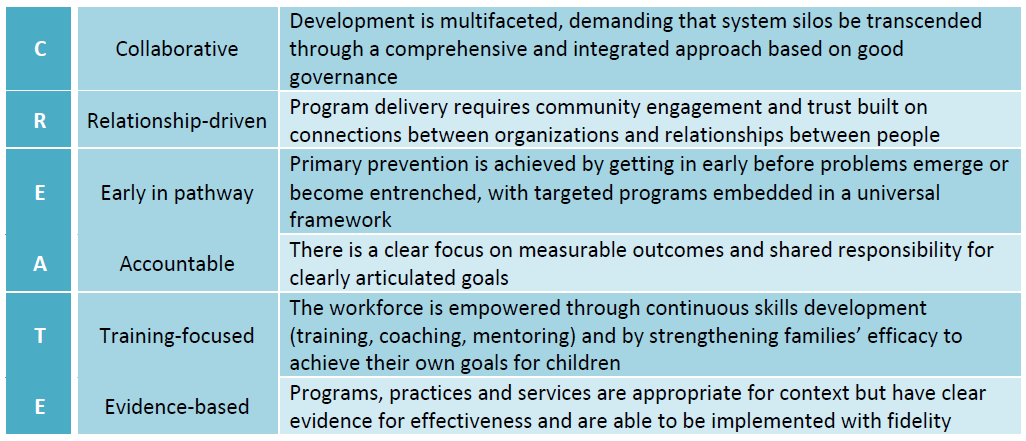
The goal of the CREATE Project was to build and implement a Prevention Translation and Support System (PTSS) progressively in Communities for Children (CfC) sites in NSW, Queensland and Tasmania, and to evaluate its impact on measures of child wellbeing, educational performance, and behaviour, as well as on family-school engagement and the quality of functioning of local partnerships involving schools and community agencies.
The PTSS incorporates a range of electronic tools and resources, and the services of Collective Change Facilitators (CCFs) in each community. The PTSS is a set of structured processes and resources that equip community partnerships (or coalitions) to achieve their aims. The PTSS blends face-to-face guidance, mentoring and coaching provided by CCFs with a comprehensive range of interactive on-line resources and training. A CCF helps bridge the gap between prevention science and routine community practices, guiding local partnerships as they move beyond the status quo toward the scientific practice of collective impact.
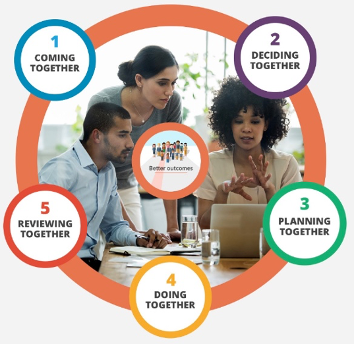
The PTSS resources were designed to support community coalitions as they moved through the fives phases of the CREATE Change Cycle:
Electronic tools and resources
Informative videos; and an extensive array of tools and resources to guide the coalitions through the CREATE change cycle;
A validated measure of child wellbeing: Rumble’s Quest, a 30-minute video game for 6-12 year-old children
The Parent Empowerment and Efficacy Measure (PEEM); on line, called Parent's Voice
A comprehensive on-line tool for measuring, reporting, and acting on the quality of functioning of CfC community partnerships (the Coalition Wellbeing Survey)
Publications
These publications include papers reporting the theory, development, implementation, evaluation, and dissemination of the Pathways and CREATE Projects, as well as publications that develop the theory and research foundations of developmental prevention building (in part) on both projects (e.g., Homel, 2005). In addition, policy papers, commentaries and lectures related to the project are listed. Papers in preparation are not listed, nor are reports and commentaries that are no longer easily accessible, but we do include papers available in preprint or ‘under review’ format.
Foundation report | Reports on the Pathways to Prevention Project | Articles and book chapters on the Pathways to Prevention Project | Reports, articles, and book chapters on the CREATE Project | Edited volumes about developmental prevention | Papers on the theory and research foundations of developmental prevention | Commentaries, policy papers, lectures
Foundation report
Developmental Crime Prevention Consortium (1999). Pathways to prevention: Developmental and early intervention approaches to crime in Australia(Full Report, Summary and Appendices) (400 pages). Canberra: Australian Government Publishing Service. Available from the following web site in three volumes: https://doi.org/10.13140/RG.2.2.16749.56800
Selected Reports on the Pathways to Prevention Project
Homel, R., Freiberg, K., Lamb, C., Leech, M., Hampshire, A., Hay, I., Elias, G., Carr, A., Manning, M., Teague, R. & Batchelor, S. (2006). The Pathways to Prevention Project: The First Five Years, 1999-2004. Sydney: Griffith University & Mission Australia.
Homel, R., Freiberg, K., Branch, S., Haskard, K., Teague, R., Thompson, P. & Mobbs, S. (2016). Can family support moderate the relationship between disciplinary suspensions and child outcomes? Report to Qld Dept Education. Brisbane: Griffith University.
Homel, R., Freiberg, K., Branch, S. & Le, H. (2015). Preventing the onset of youth offending: The impact of the Pathways to Prevention Project on the behaviour and wellbeing of children and young people(88 pages). Canberra: Report to the Criminology Research Advisory Council May 2015, Grant: CRG 30/11-12.
Allen, J., Homel, R., Vasco, D. & Freiberg, K. (2024). The impact of a preschool communication program and comprehensive family support on serious youth offending: New findings from the Pathways to Prevention Project. Canberra: Australian Institute of Criminology.
Articles and book chapters on the Pathways to Prevention Project
Homel, R. (1998). Pathways to prevention. From page 91 in Crime Prevention Through Social Support: Proceedings of Conference, May 26, 1998, Parliament House, Sydney. Sydney: Parliament of New South Wales, Standing Committee on Law & Justice.
Homel, R., Elias, G. & Hay, I. (2001). Developmental prevention in disadvantaged communities. In Eckersley, R., Dixon, J. & Douglas, R. (Eds), The Social Origins of Health and Well-being: From the Planetary to the Molecular (pp. 269-279), Melbourne: Cambridge University Press.
Elias, G., Hay, I., Homel, R., Freiberg, K. Prothero, C & Ernst, R. (2002). Enhancing non-English speaking preschoolers’ emergent literacy skills. ThaiTESOL Bulletin 15(2): 63-68.
Hay, I., Elias, G., Homel, R., Freiberg, K., Ernst, R., & Jensen, H. (2003). Nature and Extent of Preschoolers' Language Delays in a Disadvantaged Community. In B. Bartlett, F. Bryer, & D. Roebuck (Eds.). Reimagining practice: Researching change. (Vol 2, pp. 41-47) refereed proceedings of 1st International Conference on Cognition, Language & Special Education, Gold Coast Queensland, 5-7th Dec.
Freiberg, K., Homel, R., Batchelor, S., Carr, A., Lamb, C., Hay, I., Elias, G. & Teague, R. (2005). Creating Pathways to participation: A community-based developmental prevention project in Australia. Children and Society, 19: 144-157.
Elias, G., Hay, I., Homel, R., & Freiberg, K. (2006). Enhancing parent-child book reading in a disadvantaged community. Australian Journal of Early Childhood, 31, 20-25.
Homel, R., Freiberg, K., Lamb, C., Leech, M., Batchelor, S., Carr, A., Hay, I., Teague, R. & Elias, G. (2006). The Pathways to Prevention Project: Doing developmental prevention in a disadvantaged community. Trends and Issues 323: 1-6.
Freiberg, K., Homel, R. & Lamb, C. (2007). The pervasive impact of poverty on children: tackling family adversity and promoting child development through the pathways to prevention project. In France, A. & Homel, R. (Eds.), Pathways and Crime Prevention: Theory, Policy and Practice (pp. 226-246). Cullumpton, Devon, UK: Willan Publishing
Manning, M., Homel, R. & Smith, C. (2006). Economic evaluation of a community based early intervention program implemented in a disadvantaged urban area of Queensland. Economic Analysis and Policy 36: 1-21.
Homel, R., Lamb, C. & Freiberg, K. (2006). Working with the Indigenous community in the Pathways to Prevention Project. Family Matters, 75: 36-41.
Leech, M., Anderson, C. and Mahoney, C. (2007). Research-practice-policy intersections in the Pathways to Prevention Project: Reflections on theory and experience. In France, A. & Homel, R. (Eds.), Pathways and Crime Prevention: Theory, Policy and Practice (pp. 247-270). Cullumpton, Devon, UK: Willan Publishing
Hay, I., Elias, G., Fielding-Barnsley, R., Homel, R. & Freiberg, K. (2007). Language delays, reading delays and learning difficulties: Interactive elements requiring multidimensional programming. Journal of Learning Disabilities, 40, 400-409.
Freiberg, K., Homel, R. & Branch, S. (2010). Circles of Care: The struggle to strengthen the developmental system through the Pathways to Prevention project. Family Matters, 84, 28-34.
Manning, M, Homel, R & Smith, C. (2010). A meta-analysis of the effects of early developmental prevention programs in at-risk populations on non-health outcomes in adolescence. Children and Youth Services Review, 32, 506–519.
Homel, R. & Freiberg, K. (2010). Pathways to Prevention: A holistic model for developmental crime prevention in socially disadvantaged areas. In International Report - Crime Prevention and Community Safety: Trends and Perspectives (pp. 182-184). Montreal: International Centre for the Prevention of Crime.
Homel, R. (2010). Pathways to Prevention. In Bonnie S. Fisher & Steven P. Lab (Eds.), Encyclopedia of Victimology and Crime Prevention (pp. 622-624). Thousand Oaks, CA: SAGE.
Homel, R. (2009). An alternative vision for crime control. Proctor, Journal of the Law Society of Queensland (pp. 17-18), May 2009.
Freiberg, K. & Homel, R. (2011). Preventing the onset of offending. In Anna Stewart, Troy Allard & Susan Dennison (Eds.) Evidence-Based Policy and Practice in Juvenile Justice (pp. 320-333). Sydney: Federation Press
Branch, S., Homel, R. & Freiberg, K. (2012). Making the developmental system work better for children: Lessons learned from the Circles of Care Programme. Child and Family Social Work 18, 294-304.
Freiberg, K.; Homel, R. & Branch, S. (2014). The Parent Empowerment and Efficacy Measure (PEEM): A Tool for Strengthening the Accountability and Effectiveness of Family Support Services. Australian Social Work, 67(3), 405-418.
Homel, R., Freiberg, K., Branch, S. & Le, H. (2015). Preventing the onset of youth offending: The impact of the Pathways to Prevention Project on child behaviour and wellbeing. Trends and Issues in Crime and Justice, 481, May 2015.
Freiberg, K., Homel, R., Branch, S., Allen, J., McGee, T.R., Vasco, D. & Haskard, K. (2023). The development and properties of a scalable digital measure of social and emotional wellbeing for middle childhood. Applied Developmental Science.
Allen, J., Homel, R., Freiberg, K. & Vasco, D. (2024). Family support, enriched preschool and serious youth offending. Trends and Issues in Crime and Justice. Australian Institute of Criminology.
Manning, M., Wong, G.T., Homel, R., Allen, J., Freiberg, K. (under review, 2025). The rate of return to the Pathways to Prevention Project from the reduced probability of the onset of serious youth offending.
Baldry, E. & Homel, R. (in press, 2025). Children, young people and place: A tribute to the pioneering work of Tony Vinson, AM. Chapter 16 in Tim Reddel and Lutfun Nahar Lata(Eds.), Place, Community and Governance in Australia: Past, Present and Futures. Bloomsbury Publishing.
Reports, articles, and book chapters on the CREATE Project
Branch, S., Homel, R. & Freiberg, K. (2020). CREATE-ing Pathways to Child Wellbeing in Disadvantaged Communities - Phases 2 and 3 (2016-2020): The Collective Impact Facilitator Role - Overview. Griffith Criminology Institute. Brisbane, Australia.
Allen, J., Homel, R., McGee, T. & Freiberg, K. (2023). Child well-being before and after the 2020 COVID-19 lockdowns in three Australian states. Australian Journal of Social Issues, 58(1), 41-69.
Homel, R., Branch, S. & Freiberg, K. (2023). Building capacity for sustainable, scalable, place-based youth crime prevention. Chapter 14 (pp. 148-160) in C. Malvaso, T.R. McGee & R. Homel (Eds.), Frontiers in developmental and life-course criminology: Methodological innovation and social benefit. UK: Routledge.
Freiberg, K. & Homel, R. (2023). Rumbles Quest: A Digital Game-Based Assessment of Social and Emotional Wellbeing in Middle Childhood.Chapter 8 (pp. 80-90) in C. Malvaso, T.R. McGee & R. Homel (Eds.), Frontiers in developmental and life-course criminology: Methodological innovation and social benefit. UK: Routledge.
Branch, S., Freiberg, K., Homel, R. & Stubbs, C. (2022). The importance of access, time and space – developing the collective change facilitator role as part of a multi-partner research program. In Leslie Wood (Ed.), Community-based research with vulnerable populations: Ethical, Inclusive and Sustainable Frameworks for Knowledge Generation (pp. 205-220). London, UK: Springer Nature Ltd. ISBN: 978-3-030-86401-9.
Homel, J., Homel, R., McGee, T.R., Zardo, P., Branch, S., Freiberg, K., Manning, M. & Wong, G. (2021). Evaluation of a place-based collective impact initiative through cross-sectoral data linkage. Australian Journal of Social Issues, 56(2), 301-318.
Branch, S; Freiberg, K and Homel, R. (2019). Strengthening the prevention delivery system for children in disadvantaged communities through infrastructure development. Developing Practice: The Child, Youth and Family Work Journal, 53, 54-73.
Day, J., Freiberg, K., Hayes, A. & Homel, R. (2019). Towards Scalable, Integrative Assessment of Children’s Self-Regulatory Capabilities: New Applications of Digital Technology. Clinical Child and Family Psychology Review, 22:90-103.
Homel, R., Branch, S. & Freiberg, K. (2019). Implementation through community coalitions: The power of technology and community-based intermediaries. Commentary, special issue on Implementation and Adaptation: Measurement and Monitoring Systems of the Journal of Primary Prevention,40:143-148. First online.
Homel, R., Freiberg, K. & Branch, S. (2015). CREATE-ing capacity to take developmental crime prevention to scale: A community-based approach within a national framework. Australian and New Zealand Journal of Criminology 48(3): 367-385.
Edited volumes about developmental prevention
France, A. & Homel, R. (2007). Pathways and Crime Prevention: Theory, Policy and Practice. Cullumpton, Devon, UK: Willan Publishing
France, A. & Homel, R. (2006). Pathways and Prevention. Special Issue of the Australian and New Zealand Journal of Criminology, 39.
McGee, T.R., Farrington, D.P., Homel, R. & Piquero, A.R. (Eds.) (2015) Advancing knowledge about developmental and life-course criminology. Special issue on developmental and life course criminology, Australian and New Zealand Journal of Criminology, 48(3)
Malvaso, C., McGee, T. & Homel, R. (Eds.) (2023). Frontiers in Developmental and Life-Course Criminology: Methodological Innovation and Social Benefit. Routledge, UK.
Papers on the theory and research foundations of developmental prevention
Wimshurst, K. & Homel, R. (1997). The primary prevention of juvenile crime. In A. Borowski & I. O'Connor (eds.), Juvenile crime, juvenile justice, and juvenile corrections. Longman Cheshire.
Homel, R., Lincoln, R. & Herd, B. (1999). Risk and resilience: Crime and violence prevention in Aboriginal communities. Australian and New Zealand Journal of Criminology, 32, 182-196.
Homel, R. (2000). Blazing the developmental trail: The past, the future, and the critics. Youth Studies Australia, 19(1), 44-50.
France, A. & Homel, R. (2006). Societal access routes, developmental pathways and prevention policies: Putting structure, politics and culture into the analysis of pathways into and out crime. Australian and New Zealand Journal of Criminology, 39, 295-309. (Also being published in France, A. & Homel, R. (Eds.), Pathways and Crime Prevention: Theory, Policy and Practice (pp. 9-27). Cullumpton, Devon, UK: Willan Publishing).
France, A. & Homel, R. (2007). Societal access routes, developmental pathways and prevention policies: Putting structure, politics and culture into the analysis of pathways into and out crime. In France, A. & Homel, R. (Eds.), Pathways and Crime Prevention: Theory, Policy and Practice (pp. 9-27). Cullumpton, Devon, UK: Willan Publishing. (Reprinted from the Australian and New Zealand Journal of Criminology)
France, A. & Homel, R. (2006). Pathways and prevention: Concepts and controversies. Australian and New Zealand Journal of Criminology, 39, 287-294
Homel, R. (2005). Developmental crime prevention. In Nick Tilley (Ed.), Handbook of crime prevention and community safety (pp. 71-106). Cullumpton, Devon, UK: Willan Publishing
France, A. & Homel, R. (2007). Pathways and crime prevention: A difficult marriage? In France, A. & Homel, R. (Eds.), Pathways and Crime Prevention: Theory, Policy and Practice (pp. xvii-xxiii; Part One, pp. 3-8; Part Two: pp. 197-201). Cullompton, Devon, UK: Willan Publishing
Homel, R., Lincoln, R. & Herd, B. (2008). Risk and resilience: Crime and violence prevention in Aboriginal communities. In Kate Moss (Ed.), Crime Reduction: Critical Concepts in Criminology. Routledge UK: Routledge Major Works Series. (Reprinted from Australian and New Zealand Journal of Criminology, 32, 182-196.)
France, A. & Homel, R. (2008). Developmental criminology. In B. Goldson (Ed.), Dictionary of Youth Justice (pp. 139-141). Cullumpton, Devon, UK: Willan Publishing
Homel, R. (2008). Early intervention. In Peter Cane & Joanne Conaghan (Eds.), New Oxford Companion to Law (pp. 351-352). Oxford: Oxford University Press
France, A., Freiberg, K., & Homel, R. (2010). Beyond risk factors: towards a holistic prevention paradigm for children and young people. British Journal of Social Work, 40 (4): 1192-1210.
Manning, M, Homel, R & Smith, C. (2010). A meta-analysis of the effects of early developmental prevention programs in at-risk populations on non-health outcomes in adolescence. Children and Youth Services Review, 32, 506–519.
Manning, M., Homel, R. & Smith, C. (2011). An economic method for formulating better policies for positive child development. Australian Review of Public Affairs, 10(1), 61-77.
Homel, R. & Homel, P. (2012). Implementing crime prevention: Good governance and a science of implementation. In Brandon Welsh and David Farrington (Eds.), The Oxford Handbook of Crime Prevention (pp. 423-445). Oxford: Oxford University Press
Homel, R. & McGee, T. (2012). Community approaches to crime and violence prevention: Building prevention capacity. Chapter 20 in Rolf Loeber & Brandon Welsh (Eds.), The future of criminology (pp. 172-177). New York: Oxford University Press
Manning, M., Smith, C. & Homel, R. (2013). Valuing developmental crime prevention. Criminology and Public Policy, 12(2), 305-332.
Homel, R. & France, A. (2013). Developmental criminology. In Eugene McLaughlin & John Muncie (Eds.), SAGE Dictionary of Criminology (3rd Edition) (pp. 131-134). London, UK: SAGE.
McGee, T.R., Farrington, D.P., Homel, R. & Piquero, A.R. (2015) Advancing knowledge about developmental and life-course criminology. Australian and New Zealand Journal of Criminology, 48, 307-313.
Toumbourou, J.W., Leung, R., Homel, R., Freiberg, K., Satyen, L., and Hemphill, S.A. (2015). Violence prevention and early intervention: what works? In Andrew Day & Ephrem Fernandez (Eds.), Preventing violence in Australia: Policy, Practice and Solutions. (pp. 45-62). Sydney: Federation Press
Wickes, R., Homel, R. & Zahnow, R. (2016). Safety in the suburbs: Social disadvantage, community mobilization, and the prevention of violence. In J. Stubbs & S. Tomsen (Eds), Australian Violence (pp. 210-229). Sydney: Federation Press
Homel, R. & Freiberg, K. (2017). Developmental prevention. Chapter 54 in Antje Deckert & Rick Sarre (Eds.), The Australian and New Zealand Handbook of Criminology, Crime and Justice (pp. 815-830). Sydney: Palgrave Macmillan (Springer).
Homel, R. & Thomsen, L. (2017). Developmental crime prevention. In Nick Tilley & Aiden Sidebottom (Eds.). Handbook of Crime Prevention and Community Safety (2nd edition) (pp.57-86). UK: Routledge.
Homel, R. (2021). Developmental crime prevention in the 21st century: Generating better evidence and embedding it in large scale delivery systems. Journal of Developmental and Life Course Criminology 7(1), 112-125.
Homel, R. (2017). Preventing crime and recidivism: State of the art evidence, and how to apply it at scale. Editorial Introduction, Crime Prevention and Rehabilitation. Criminology and Public Policy, 16(2), 411-413.
Homel, R., Bumbarger, B., Freiberg, K. & Branch, S. (2017). Sustaining crime prevention at scale: Transforming delivery systems through prevention science. In Teasdale, B & Bradley, M (Eds.), Preventing crime and violence: Volume 3 of Advancing Prevention Science (Chapter 29) (pp. 351-376). New York: Springer.
Homel, R., Thomsen, L., Freiberg, K. & Branch, S. (2018). Social and developmental crime prevention. Published in Spanish in Mariano Juan Tenca & Emiliano Pedro Mendez Ortiz (Eds.), Manual de Prevención del Delito y Seguridad Comunitaria/ Handbook of Crime Prevention and Community Safety. Buenos Aires, Argentina: Ediciones Dido.
Allen, J., Homel, R., McLaws, S., Evans-Whipp, T., Olsson, C.& the Paul Ramsay Foundation Early Relational Health Network (under review, 2025). A living scoping review of universal interventions for promoting relational health in childhood, adolescence and young adulthood.
Commentaries, policy papers, lectures
Homel, R. (2007). Comment on Richard Tremblay, The development of youth violence: An old story with new data. European Journal on Criminal Policy and Research
Homel, R. (2006). Open doors or prison walls? Griffith Review Edition 11 – Getting Smart: 173-183.
Homel, R. (2005). The puzzles and paradoxes of youth crime prevention. Safer Society, 27 Winter: 2-4. London: NACRO (the crime reduction charity).
Homel, R. (2006). As if children mattered … New Matilda Policy Portal, September 18, 2006. Reprinted in Australian Children’s Rights News, 41, September 2006, pages 12-14
Homel, R. (2019). As if children mattered … Creating pathways to wellbeing. Griffith Review 65: Crimes and Punishments, 140-163.
Homel, R. (2024). The primary prevention of youth crime in Queensland: A proposal for community-controlled, data-guided, evidence-based early prevention initiatives in selected Queensland communities. Submission to Queensland Government Enquiry: Putting Queensland Kids First and the New South Wales Parliamentary Enquiry into Community Safety in Regional and Rural Communities
Allen, J., Homel, R. & Freiberg, K. (October 24, 2024). The Conversation: https://theconversation.com/we-tried-a-different-preschool-curriculum-to-prevent-youth-crime-checking-in-20-years-later-it-worked-235888